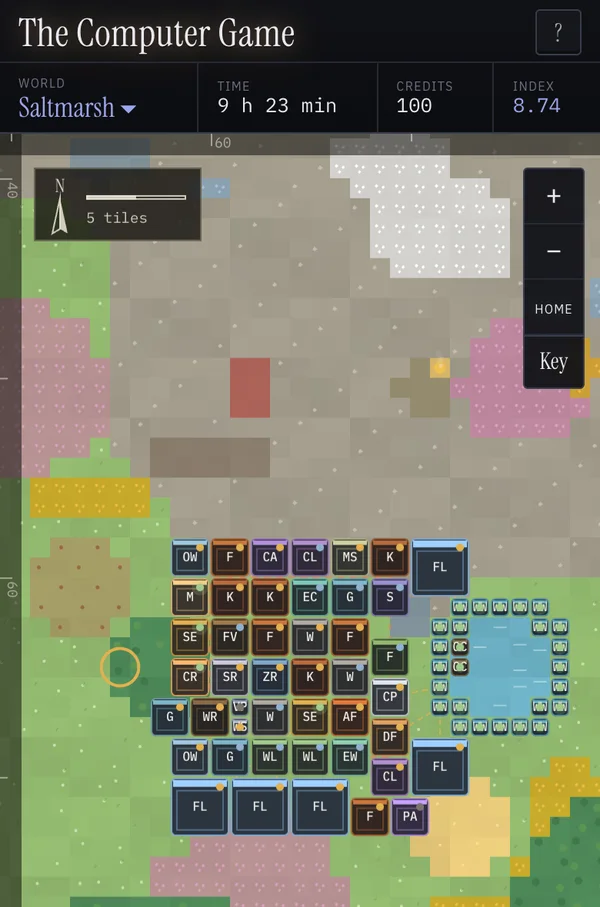
What it is
The Computer Game is a strategy game about how computers come to be. Not the story of who invented what, but the work itself: the materials, the machines that make machines, and the physics that decides what is possible.
Every world is a fresh map with its own deposits: sand, clay, copper, coal, salt, seaweed and more. You gather by hand, then build workshops, kilns and furnaces that work for you. What you make teaches your world new things. What your world knows decides what you can build next.
There is no tech tree to click through. Knowledge is discovered by doing. The moment your world first smelts copper, it knows smelting. The moment it grows a culture in agar, it knows microbiology. Your map decides what is cheap, so no two worlds take the same road.
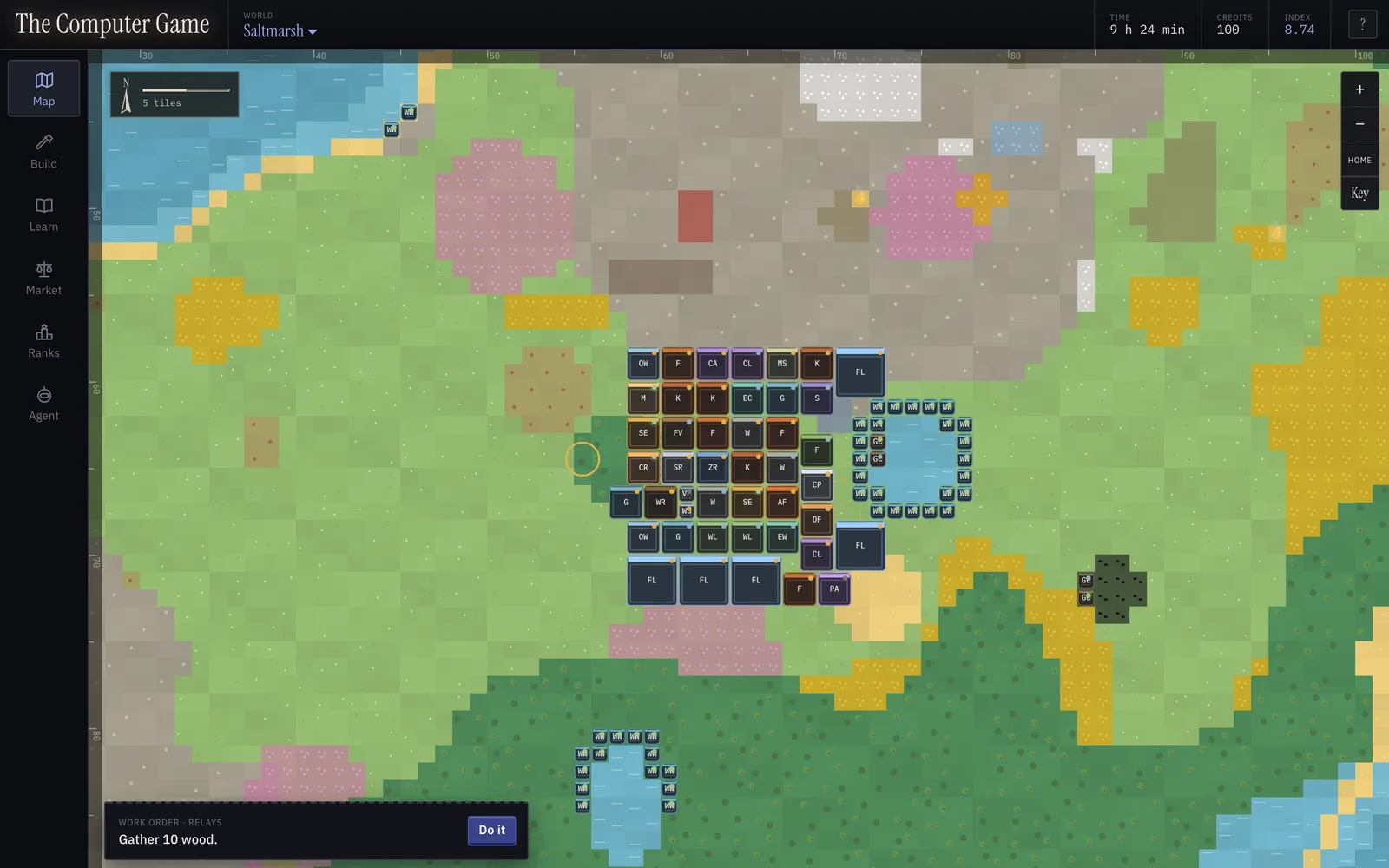
The goal
Build the most capable computing your world can. One number measures it: the Compute Index.
The Index counts real work your machines do, in five families. A DNA computer searching for a path counts. A relay computer adding numbers counts. A rack of chips you designed, running matrix multiplies, counts. So does data written into DNA and read back a day later.
The scale is logarithmic on purpose. A first relay computer and a modern accelerator both fit on it. In the game's own calibration, eight current datacenter accelerators score about 16 to 18 in each family. The Index has no ceiling.
How a world works
A world is a map, a store of materials, a set of buildings and what it knows. The server runs it, so it keeps going when you close the tab.
- Gather by hand. Wood, stone, sand, clay and water. Hand labour is limited and refills with time, so you soon want camps that gather for you.
- Place buildings on the map. A camp works the deposit it stands on. Farther from home means slower hauling, so where you build matters.
- Set recipes. A kiln can make charcoal, ash, glass or ceramic. You choose, and you can set limits so it stops when the store is full.
- Power it. Water wheels, steam engines and generators feed a grid. Short on power, machines slow down and computers stop counting. Out of fuel, everything stops.
- Follow the work order. The game always shows one useful next step, with a button that does it. Ignore it whenever you like.
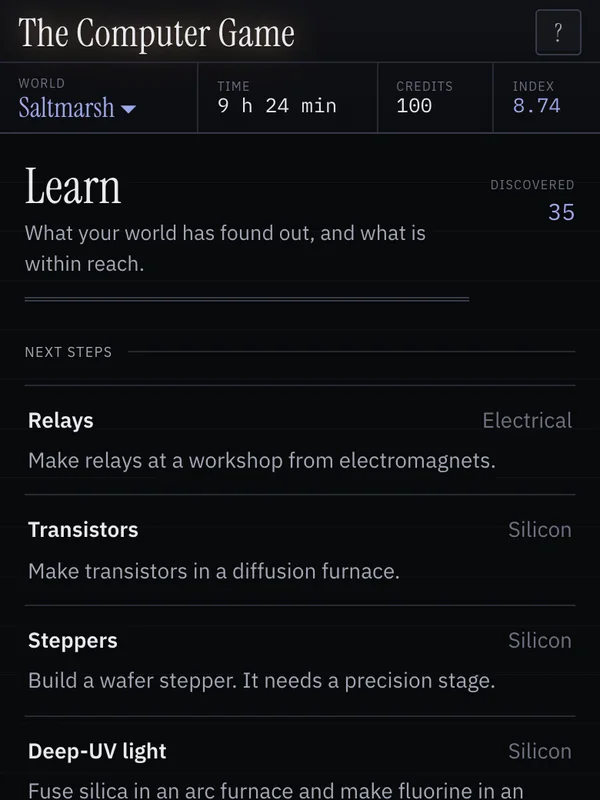
Open roads
History took one path to the computer. Physics allows several. You do not pick a road. You reach one by what you make.
Every world starts with the foundations: fire, farming, glass, salt, charcoal and metal. From there, three roads lead to working computers. You can walk more than one, and they feed each other. Glassware helps the microbiologist. Copper wire helps everyone.
Molecular
Microbes, enzymes and DNA. Grow cultures on agar from seaweed, find heat-loving bacteria, copy DNA with PCR and read it with gels and sequencing.
- DNA computing1994
- DNA storage2012
- Sequencing1977
Electrical
Zinc and copper make batteries. Current makes magnets. Magnets move switches. Enough switches make a machine that follows a program.
- Electricity1800
- Relays1835
- Relay computing1941
Silicon
Arc furnaces, hyperpure silicon, single crystals and wafers. Then doping, transistors, and printing circuits with light, finer and finer.
- Integrated circuits1958
- Microprocessors1971
- Gate-all-around2022
Making chips
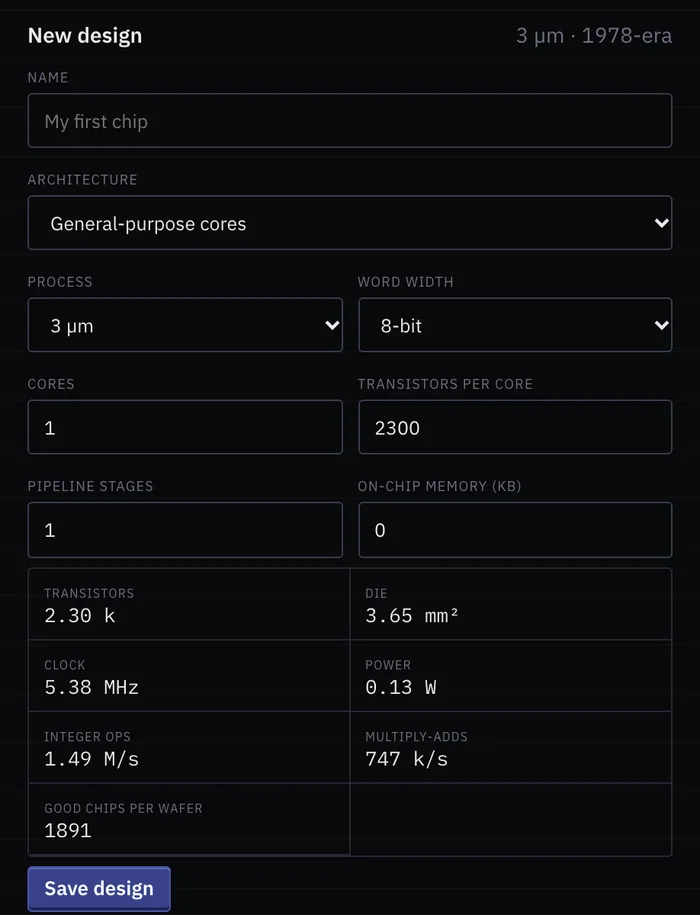
On the silicon road you design your own chips, and the game evaluates them with real process data.
Choose an architecture (general-purpose cores, cores with vector lanes, or a systolic matrix engine), the number of cores, transistors per core, word width, pipeline depth and on-chip memory. The game works out the die size, clock, power, operations per second and how many good chips you get from a wafer.
Then your fab lines make them, and your racks put them to work. Pair them with DRAM, and later with stacked high-bandwidth memory, because a fast chip starved of data is a slow chip.
Printing with light
The finest line a machine can print follows the Rayleigh limit. Shorter light and wider lenses print finer. So does cleverness, which is the factor k1.
| Machine | Light | λ | NA | Finest half-pitch |
|---|---|---|---|---|
| Contact aligner | Lamp, mask touching the wafer | 450 nm | n/a | 5 µm |
| Projection aligner | Mercury arc lamp (i-line) | 365 nm | 0.35 | 626 nm |
| Wafer stepper | Mercury arc lamp (i-line) | 365 nm | 0.60 | 365 nm |
| Deep-UV scanner | KrF excimer laser, phase-shift masks | 248 nm | 0.75 | 132 nm |
| ArF scanner | ArF excimer laser, computed masks | 193 nm | 0.75 | 72 nm |
| Immersion scanner | ArF laser through a film of water | 193 nm | 1.35 | 40 nm |
| EUV scanner | Tin plasma, multilayer mirrors | 13.5 nm | 0.33 | 16.4 nm |
Below what one exposure can print, you can expose twice or four times, each time shifted. It works, and it costs time on every wafer. Smaller than the light's wavelength, every mask edge must be simulated and pre-distorted, and that compute runs on your own racks. Your computers help build the next ones.
Transistors change too. Planar transistors leak at small sizes, so you need strained silicon, then high-k metal gates, then FinFETs, then gate-all-around. Each one is a discovery your world has to make. Yield follows a Poisson model: bigger dies catch more defects, so a huge chip is a gamble.
In our world
Each discovery shows a mirror: when and where our own civilization first did the same thing.
Nothing in the game is gated by date. Your world might make DNA storage before it has electricity. The mirror is there so you know what you just did, and who did it first. Every fact in the game links to its source.
| Your world discovers | In our world | Who, where | What |
|---|---|---|---|
| Agriculture | 10,000 to 8000 BCE | Fertile Crescent | First farmed grain |
| Glassmaking | about 3600 BCE | Mesopotamia, Egypt or Syria | Earliest evidence of glassmaking |
| Vacuum | 1650 | Otto von Guericke | The first air pump |
| Electricity | 1800 | Alessandro Volta | The voltaic pile |
| Relays | 1835 | Joseph Henry | The electromechanical relay |
| Relay computing | 1941 | Konrad Zuse | Z3, the first working programmable computer |
| Integrated circuits | 1958, 1959 | Jack Kilby; Robert Noyce | The integrated circuit; the planar process |
| PCR | 1983 | Kary Mullis | The polymerase chain reaction |
| DNA computing | 1994 | Leonard Adleman | A 7-city route problem solved in DNA |
| Extreme ultraviolet | 2019 | ASML and TSMC | EUV lithography in volume production |
Worlds can fall
Coal runs out. Forests do not grow back on their own. A world that burns through its fuel can stall for good.
That is deliberate. Planting a tree nursery, building water wheels or moving to steam are choices with weight. If a world does fall, it stays in the rankings as a memorial, read-only, exactly as it was. You can also abandon a world yourself. Worlds are never deleted.
You can keep up to 3 living worlds and start up to 3 new worlds a day.
Play with an AI agent
The game is a hosted MCP server. Connect Claude, ChatGPT or any app that speaks MCP, and it plays the same world you do, by the same rules.
Address:
- Claude app or claude.ai. Open Settings, then Connectors, then Add custom connector. Paste the address and sign in with your game account. It then works in the Claude app on your phone too.
- ChatGPT. Turn on Developer mode (Settings, then Security and login), add the address at chatgpt.com/plugins, sign in, then switch it on in a new chat.
- Claude Code or Codex. One command in a terminal, then sign in.
Step-by-step setup for each app
An agent can see the world, ask for the next step, act, wait, inspect any process or a chip design, trade on the market, read the rankings, visit other worlds, and keep a notebook saved with the world. You can watch it play on the map and take over at any time.
Questions
Is it free?
Yes. You need a free account so the server can keep your worlds.
Do I need to install anything?
No. It runs in any modern browser, on a phone or a computer. Your worlds live on the server, so you can switch devices.
What happens when I close the tab?
Your world keeps running on the server. When you come back, it has caught up to the present.
Is the science real?
The physics is real and the numbers come from measured data: the Rayleigh limit for printing, real light sources and lenses, process data for transistors, and Poisson yield for chips. Some processes are simplified so a world can play in hours, not decades.
How long does it take to build a first computer?
A few hours of game time on most maps. Getting to modern chips takes days, and the Index never stops.
Can I play with friends?
Yes, through the market and rankings. You can trade with their worlds, visit them and race them.